
Stainless Steel Jewelry Manufacturing: Why PVD Lasts
A coating lasts because of how it is bonded and what it is bonded to, not because of how much of it is applied. PVD vacuum plating deposits its layer in a sealed chamber onto a base metal that does not corrode on its own, which is the combination a steel line is built on. Behind that single step sit eight documented factory stages, 100% inspection before packing, and three published compliance documents.

Key takeaways
- PVD vacuum plating is the published finish for stainless steel; silver and brass take multi-layer electroplating plus an anti-tarnish e-coating.
- Plating is the sixth of 8 factory steps, so only inspection and packing follow it.
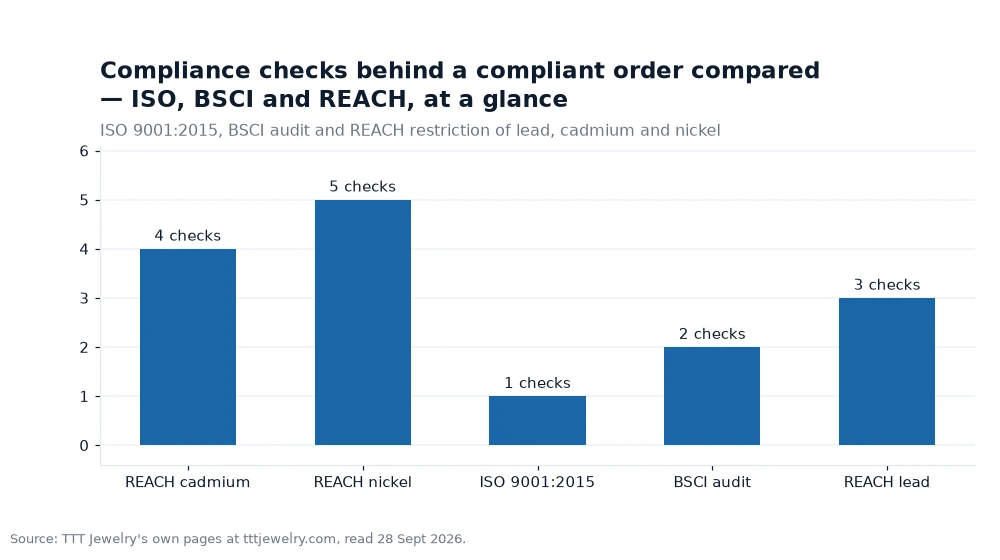
- A BSCI audit, the ISO 9001:2015 standard and REACH compliance on lead, cadmium and nickel are the documents behind a compliance claim.
- Steel orders start at 100–150 pcs by style, with a 25–35 day sampling window and 3–4 weeks of production.
What "lasts" actually depends on
Wear on a plated piece comes from two directions at once: abrasion that removes material, and corrosion that attacks whatever is underneath once the surface is breached. A wet-plated layer over a reactive base metal fails faster when both happen together, because the exposed metal underneath starts a reaction of its own. Stainless steel removes the second half of that problem, since the alloy resists corrosion through its own composition.
PVD addresses the first half. In a vacuum chamber the coating material is vaporised and deposited onto the surface, and because it arrives as a deposited film rather than as a grown crystal layer from a bath, it can be made hard and dense. It is also a dry process, which means there are no rinse tanks and no drying steps to trap moisture inside a hollow link or behind a setting.
Where the plating step sits — and what it does not fix
The published sequence runs the concept and CAD stage and prototype and mould work, through cutting the sprue, polishing and brushed and textured surface art, into the plating step, final QC inspection and final delivery. Plating is step six. Two operations follow it, and neither of them touches the surface of the piece.
That position explains the honest limits of any coating. A scratch applied at the polishing stage is coated along with everything else, and so is a soft edge from sprue cutting. The chamber reproduces the surface it receives, so the finishing steps before it are where wear life is really decided. This is also why a late colour change costs a piece rather than a minute of bench time: reopening the polished surface means reopening the earlier steps first.
Reading the three compliance documents correctly
| Item | Published scope | Question it answers |
|---|---|---|
| ISO 9001:2015 | Quality control system across all production stages | Is the process documented and repeatable? |
| BSCI audit | Labour practices, working conditions, supply chain ethics | Who makes the product, and under what conditions? |
| REACH — lead | Restricted substance limit | Is lead controlled in the materials used? |
| REACH — cadmium | Restricted substance limit | Is cadmium controlled in the materials used? |
| REACH — nickel | Restricted substance limit | Is nickel controlled on a skin-contact item? |
Three of those five items are substance limits and two are system audits, which is a useful split to remember when a retail partner asks a general question about compliance. A quality certificate cannot answer a nickel question, and a materials statement cannot tell you how a second production run will behave. Ask for the item that matches the question.
Worked example: two numbers that describe control
Number the factory steps and look at what follows plating: step six, then final QC and delivery. That is 2 ÷ 8 = 0.25, or 25% of the sequence after the point of no return for a finish change. Everything that determines how the piece looks and wears — design, prototyping, sprue cutting, polishing, surface art — sits in the first 5 ÷ 8 = 62.5%.
The compliance list divides the same way. Five named items, of which three are substance limits for lead, cadmium and nickel: 3 ÷ 5 = 60%. The remaining 2 ÷ 5 = 40% are the system audits. In practice that means the materials side carries more written checks than the process side, and a buyer assembling a file for a retailer should expect to collect three substance statements and two audit documents rather than one certificate with a logo on it.
Why steel keeps its promise in daily wear
Steel is chosen for pieces that are meant to be forgotten about: rings that stay on through washing up, chains worn against skin in summer, bracelets that meet desk edges every day. The material tolerates the water and the sweat, and the deposited coating handles the colour. Nothing about that combination requires the customer to change their habits.
It is worth saying plainly what no coating does: surface layers wear with enough abrasion, and a scuffed finish is a matter of when rather than if. The useful claim is about the metal underneath, which does not tarnish on its own, and about the process, which is documented across all eight steps and checked at 100% inspection before packing. A product page written to that standard survives a complaint; one written as an absolute does not.
Adhesion is where 316L earns the premium label. The published comparison rates PVD adhesion optimal on 316L, which carries 2–3% molybdenum and is 100% waterproof, and reliable on 304, the cost-effective grade aimed at high-volume wholesale and fast fashion. Both take the same vacuum step in the same eighth of the process; what changes is how well the deposited layer grips. The same page publishes the low MOQ at 100–150 pcs by style, so the grade decision is a tier decision rather than a volume one.
Frequently asked questions
How much longer does PVD last than wet plating?
No published figure compares the two, and any number would be invented. What is documented is the difference in method: PVD deposits the layer in a vacuum chamber onto stainless steel, while silver and brass take multi-layer electroplating plus an anti-tarnish e-coating.
Does the plating step come before or after the hallmark?
The mark is applied by laser engraving alongside the brand logo and is settled on the CAD drawing within 48 hours, so the layout is fixed before the sample reaches the plating stage.
Which documents should I ask for first?
Start with the materials statement, because REACH limits on lead, cadmium and nickel answer the questions retailers ask most often about skin contact; the ISO 9001:2015 and BSCI documents cover process and labour instead.
Specifying a steel line that will still look right next season
Fix the surface before you fix the colour, because the chamber reproduces whatever the bench sends it. Ask which of the eight steps are subcontracted, confirm that inspection runs at 100% before packing, and keep the materials statement on file next to the artwork. The full specification for the steel route sits at www.tttjewelry.com/stainless-steel-jewelry-manufacturer/, and two related pages are worth reading alongside it: the OEM and ODM service outline for how a brand-owned CAD file is handled, and the factory process page for the eight stages in sequence.
Where the numbers come from — the stainless PVD option along with the 25–35 day custom sample window plus the 316L / 304 grade comparison — is the factory's own site on tttjewelry.com's own pages, from my own reading on 28 Sept 2026. No figure above is estimated. Reading the published windows against each other is my own rather than the manufacturer's[1].