
China Perfume OEM, Two Ways: A Comparison for an EU-Compliant Launch
For an EU-compliant launch, the choice between a coordinating supplier and a factory that compounds and fills on one site will decide more of your project than any difference in unit price. The trading route is faster to start and easier to replace, but it splits responsibility for formula, fill and paperwork across two or three companies. The single-site route takes longer to onboard and is harder to swap out, yet it keeps one party accountable when a compliance question lands. Brands that struggle in the EU rarely picked the wrong price; they picked the wrong structure.
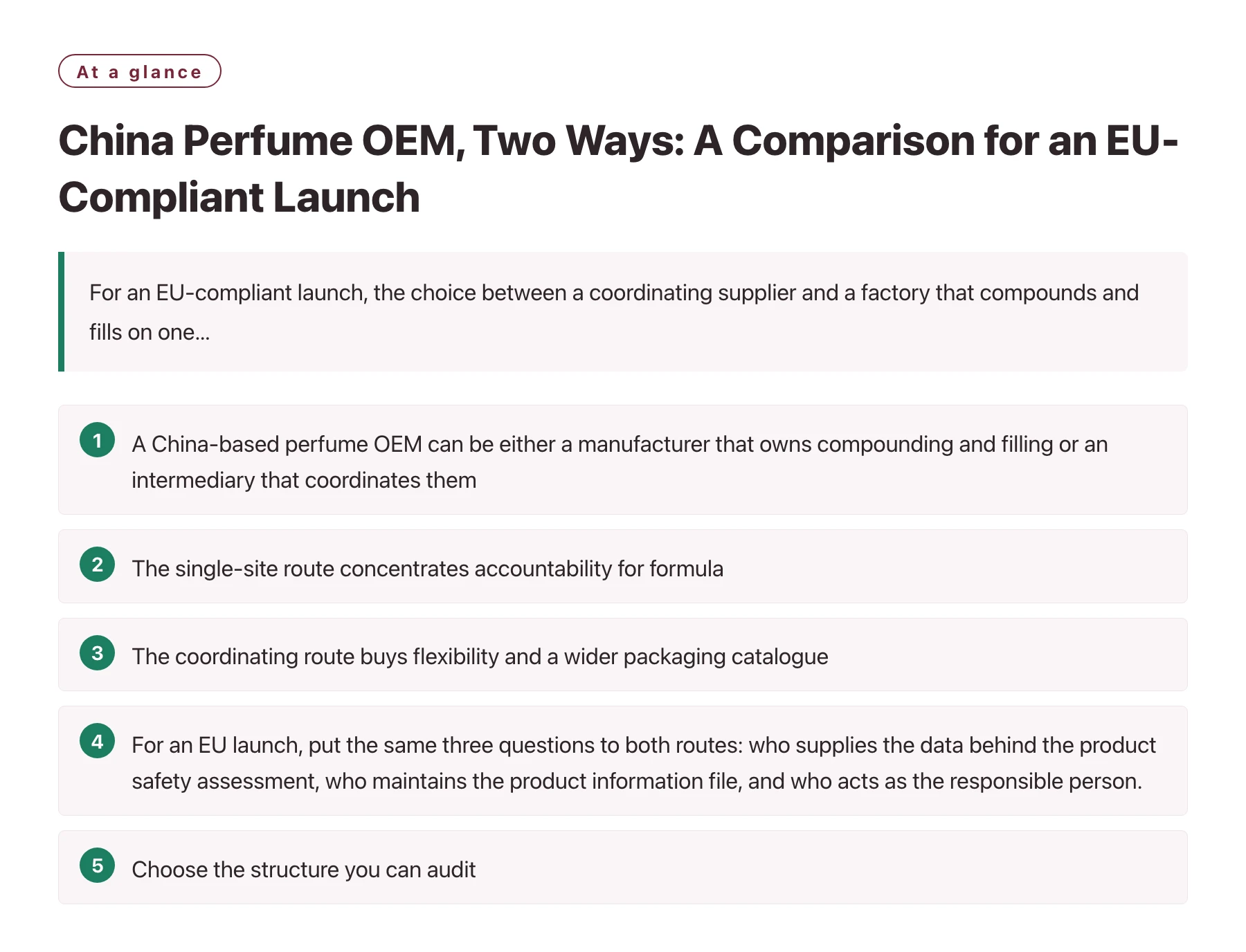
Key takeawaysA China-based perfume OEM can be either a manufacturer that owns compounding and filling or an intermediary that coordinates them, and the two behave very differently once a compliance question arrives. · The single-site route concentrates accountability for formula, fill and documentation in one legal entity, which shortens the distance between asking for a document and receiving it. · The coordinating route buys flexibility and a wider packaging catalogue, but the brand usually has to arbitrate between the filling plant and the trader itself. · For an EU launch, put the same three questions to both routes: who supplies the data behind the product safety assessment, who maintains the product information file, and who acts as the responsible person. · Choose the structure you can audit, because a route you can visit, question and correct is worth more than a lower quote you cannot verify. · Both routes can work, and neither is automatically compliant; the structure only decides how quickly a problem is found and how clearly it is owned.
Ask five Chinese suppliers for an OEM quotation and you will receive five documents that look broadly similar: a unit price, a minimum order quantity, a lead time, and a list of services. What those documents do not show is whether the sender owns a compounding hall and a filling line or whether it will place your order with a third party and add a margin. That difference is invisible on a quotation sheet and decisive on a launch calendar.
This comparison is written for a brand preparing a first or second EU-bound fragrance order, where the cosmetic regulation, the labelling duties and the safety assessment all have to be satisfied before goods can be sold. It sets out how the two structures differ in practice, where each one costs more than it appears to, and which questions separate them in a single meeting.
It is not an argument that one route is always right. Small test volumes, unusual glass, and time-pressured sampling can all favour a coordinator. The point is to make the choice deliberately, on the criteria that the launch will actually be judged by.
Two routes hiding behind one label
The first structure is a manufacturer that develops the fragrance, compounds the concentrate, fills and packs the finished product, and issues the technical documentation from one site. When you ask this kind of OEM perfume manufacturer in China how a formula change affects the safety assessment, the answer comes from the person who wrote the formula, because both live in the same building.
The second structure is a coordinator. It may hold a licence, a customer list and a network of factories, while compounding happens at one plant and filling at another. The coordinator is often excellent at sourcing packaging and at absorbing small orders that a large plant would refuse, which is a real service rather than a trick. The complication is that the technical answer and the commercial answer now come from different companies.
European cosmetics rules place duties on the party that places the product on the market, and those duties follow the product rather than the contract. The Commission's own overview of the sector is a useful starting point for a brand founder who has not worked in a regulated category before [1]. Knowing where the duties sit is what makes the structural question concrete rather than philosophical.
A simple test separates the two in a first call. Ask which legal entity will appear on the paperwork as the producer of the bulk, and ask for the address where the concentrate is compounded. If the answer to the second question is a site that has never been mentioned before, you are speaking to a coordinator.
The same launch, compared across the decisions that matter
| Decision area | Single-site manufacturer | Coordinating supplier |
|---|---|---|
| Who owns the formula discussion | The perfumer and the plant are colleagues, so a change is assessed once and in one place | The coordinator relays questions to a third-party lab or perfumery house, adding a round trip to every revision |
| Documentation speed | Technical files, batch records and declarations are produced from the same quality system | Documents arrive from suppliers with different formats and sometimes different revision dates |
| Cost transparency | Material, filling and packaging costs sit in one quotation structure, so a line-by-line comparison is possible | The coordinator margin can be invisible, which makes like-for-like comparison harder |
| Packaging choice | Limited to moulds and suppliers the plant already qualifies, though qualification is done properly | Usually the widest catalogue, because the coordinator is not tied to one tool room |
| Change control | One quality contact signs off a change and updates the file | A change may need re-confirmation from two or three suppliers before it reaches your file |
| Audit and visits | You can walk the compounding and filling areas and meet the quality team on the same day | The visit usually shows an office and a warehouse, which tells you much less |
The table is not a scoreboard. It is a map of which conversations you will be having repeatedly for the next twelve months, and with how many companies.
Where the money actually moves
Material access and minimums
A single-site plant buys aroma materials in volumes that let it absorb a small first order inside a larger production run. A coordinator buys from whichever factory accepts the smallest batch, and that flexibility is paid for either in the price or in the standard of the documentation that comes back.
Ingredient restrictions are the reason this matters for the EU. A material that is permitted at one concentration in one product type may not be permitted in another, and the permitted level changes as the scientific committee reviews substances [2]. A supplier that compounds on site usually knows which of your candidate materials carries that risk, because it maintains the same restriction list across every project it runs.
Packaging and decoration
The coordinating route often wins on decoration and unusual components, because it can quote from several printers and moulders without committing to any of them. The trade-off appears later, when a decoration defect is found and two suppliers each have a reason why the fault belongs to the other.
If your pack is standard and your priority is a clean technical chain, the single-site route usually produces fewer arguments. If your pack is the product and you need twelve variants in three finishes, a coordinator may be the only realistic path for a first collection.
How to compare the two routes without wasting a month
- Ask for the production path in writingRequest a one-page flow that names the compounding site, the filling site and the warehouse, so the number of companies in your chain is explicit before pricing starts.
- Send the same brief to bothIdentical format, identical volume, identical pack. Different briefs produce different answers and no comparison.
- Put the compliance question firstAsk who prepares the safety assessment inputs, who holds the product information file, and how fast a formula change is reflected in both. A one-stop fragrance manufacturing partner answers this in-house; a coordinator forwards it.
- Separate the quote into four linesFormula development, bulk, filling and packing, and decoration. Ask where a perfume quote can hide costs before you accept a single total, because the total is where the structural difference is easiest to conceal.
- Decide with the second order in mindThe first order tests whether the route works; the second tests whether it scales. Choose the structure you would still want at five times the volume.
- Check the record before the shortlist closesSpend twenty minutes on its background and certifications rather than on a second presentation; a documented quality system predicts a clean document trail far better than a confident slide deck.
A useful habit before signing anything: ask each candidate to send the last three technical documents it issued for a comparable product, with the customer name removed. The speed and the internal consistency of that bundle tell you more about the route than any presentation.
Sources
- European Commission: Cosmetics in the EU —— The European Commission's overview of EU cosmetics rules, including the responsible person, product information file and safety report requirements.
- EU CosIng — Cosmetic Ingredient Database (European Commission) —— The European Commission's CosIng database of cosmetic ingredients, listing ingredient functions, restrictions and labelling requirements under EU cosmetics law.
Frequently asked questions
Is a China-based OEM automatically cheaper than a European filler?
Not automatically. Filling a concentrate that is already compounded locally removes freight and duty on bulk, and for small volumes the difference can disappear entirely. Compare fully landed cost, including packaging, testing and the staff time your team will spend on document chasing.
Can a coordinating supplier still be a good choice for an EU launch?
Yes, particularly for unusual packaging, very small first runs, or a category the coordinator has already placed on the European market. What changes is your workload: you will need to verify the documents yourself rather than relying on one quality system to keep them consistent.
Which documents should both routes provide before production starts?
At minimum a formula specification, an allergen and restriction statement, a material safety data sheet set, a stability and compatibility plan, and a written statement of who prepares and who holds the product information file.
How do we check the claim that the factory compounds in-house?
Ask for a live video walkthrough or an in-person visit that includes the compounding area, the filling line and the retained sample store. Any supplier that resists showing the compounding area is telling you something about the structure of its business.
Does the choice affect lead times?
Usually by a few weeks in the first order and much less later. The single-site route saves handover time between suppliers but can queue behind larger production runs, while the coordinating route starts faster and loses days on every document cycle.
What is the single strongest signal in this comparison?
How quickly and precisely a supplier answers a technical question that was not in its standard pack. A route that owns the technical work answers from memory; a route that relays it asks for time.
Average on-site arrival: 22 minutes. Flat-rate quote before dispatch.
Call Now — 24/7